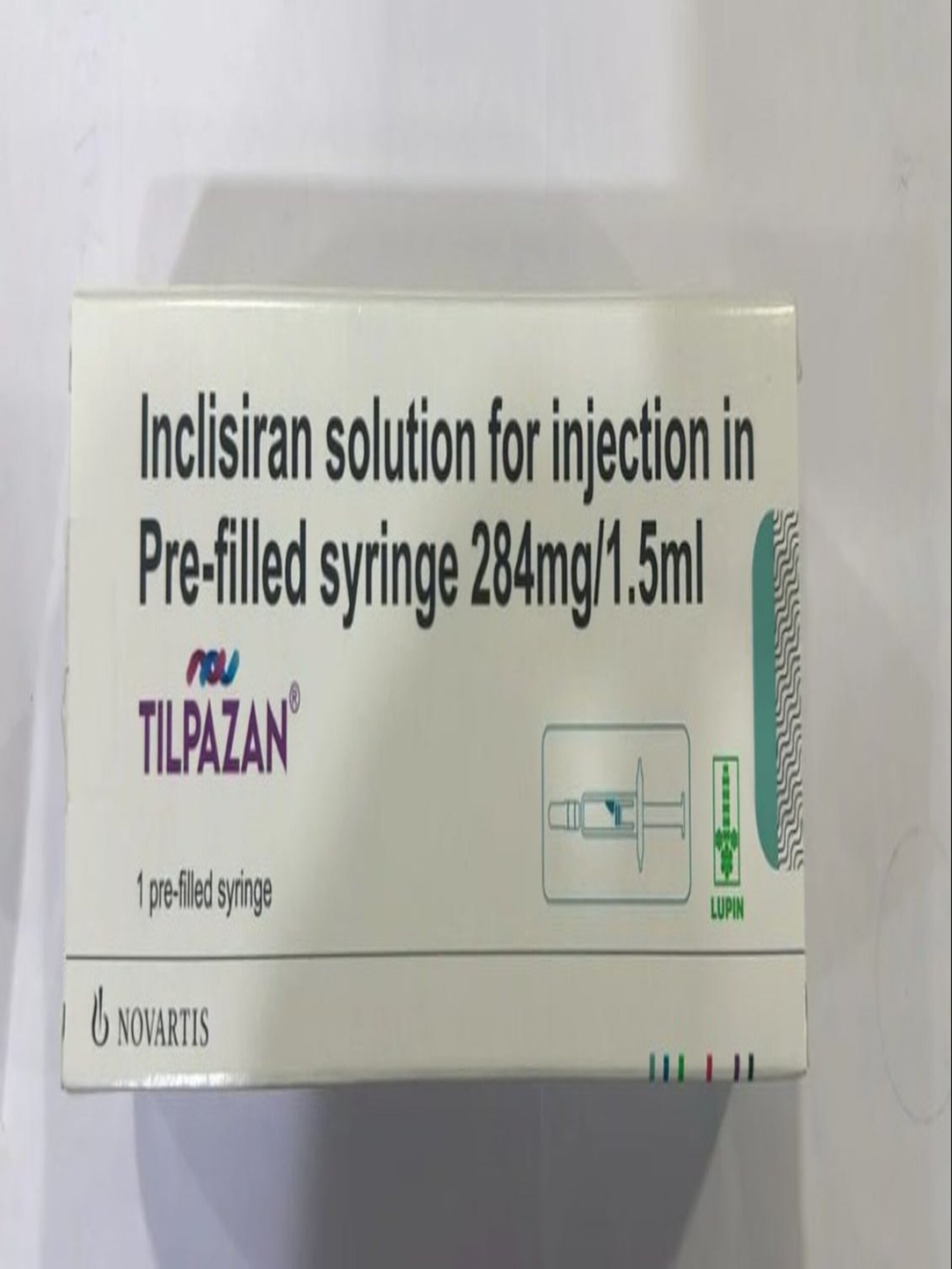


Here’s a detailed blog-style article on Tilpazan Solution for Injection (Inclisiran). You can use this for your website, educational content, or for SEO-purposes.
Tilpazan Solution for Injection: A Deep Dive into This Innovative Cholesterol-Lowering Therapy
What Is Tilpazan (Inclisiran)?
Tilpazan is the brand name for a pre-filled subcutaneous injection whose active ingredient is inclisiran (284 mg per syringe). (1mg)
It’s marketed by Lupin Ltd. (N Chimanlal Enterprises)
Tilpazan is used to lower low-density lipoprotein cholesterol (LDL-C) in adults, as an adjunct to diet and, in many cases, to maximally tolerated statin therapy. (1mg)
How Does Tilpazan Work? (Mechanism of Action)
- The core mechanism is via RNA interference (RNAi). Inclisiran is a small interfering RNA (siRNA) that specifically targets the mRNA for PCSK9 (proprotein convertase subtilisin/kexin type 9). (OUP Academic)
- It is chemically conjugated to a triantennary N-acetylgalactosamine (GalNAc) ligand. This helps it bind to asialoglycoprotein receptors (ASGPR) on hepatocytes (liver cells), enabling liver-specific uptake. (ClinicalTrials.gov)
- Once inside the cell, it is loaded onto the RNA-induced silencing complex (RISC). The RISC uses the antisense strand to bind and cleave the PCSK9 mRNA, which decreases the production of the PCSK9 protein. (ClinicalTrials.gov)
- With less PCSK9, LDL receptors on liver cells are less degraded. This means more LDL-C can be taken up from the blood, lowering circulating LDL cholesterol. (leqviohcp.com)
- The effect is long-lasting: the injection schedule is one dose at baseline, another at three months, and then every six months thereafter. (OUP Academic)
Clinical Benefits & Efficacy
- In clinical trials, inclisiran has shown ~50% reduction in LDL-C relative to baseline, even when added to statin therapy. (PubMed)
- Because of its long duration of action, it’s a less frequent dosing option compared to other PCSK9 inhibitors (like monoclonal antibodies), which often require every 2-4 weeks. (OUP Academic)
- This dosing regimen may improve adherence, especially in patients who struggle with frequent injections.
Safety & Side Effects
- According to meta-analyses, inclisiran is generally well-tolerated. (PubMed)
- The most common adverse effect is injection-site reactions, which are significantly more frequent than placebo, but tend to be mild. (PubMed)
- Pharmacokinetics: The drug reaches peak plasma concentration in about 4 hours after subcutaneous dosing, and its plasma levels become undetectable within 24–48 hours. (Drugs.com)
- Half-life (in plasma) is around 9 hours, but the effect persists much longer because of the mechanism in the liver. (Drugs.com)
- Special Populations: According to regulatory data, no dose adjustments are required for mild-to-moderate liver or kidney impairment, though severe cases need careful evaluation.
Administration Guidelines
- Given subcutaneously (under the skin) into the abdomen, thigh, or upper arm. (1mg)
- It must be administered by a healthcare professional — not recommended for self-injection, according to drug labeling. (1mg)
- Avoid injecting into areas of skin disease or infection, such as rashes or sunburned skin. (1mg)
- Storage: according to prescribing info, store at controlled room temperature. (Drugs.com)
Who Is It For? (Indications)
- Adults with elevated LDL cholesterol, especially those with atherosclerotic cardiovascular disease (ASCVD) or familial hypercholesterolemia, who are not reaching LDL-C targets despite maximally tolerated statins. (PubMed)
- It is typically add-on therapy, not a first-line replacement for statins. (PubMed)
- Because of its long dosing interval (twice a year after the initial period), it’s particularly useful for patients who have adherence challenges.
Pros & Cons: Is Tilpazan a Good Choice?
Pros
- Strong LDL-C lowering (~50%)
- Long-acting (only 2 injections/year after loading)
- Liver-targeted mechanism → efficient and specific
- Minimal systemic exposure once it’s done its job
Cons / Risks
- Injection-site reactions are common
- As a newer therapeutic modality (siRNA), long-term outcome data (e.g., on cardiovascular events) is still emerging. (PubMed)
- Requires healthcare setting to administer
- Cost may be a barrier depending on healthcare system / insurance
Real-World Implications & Patient Considerations
- Adherence Advantage
- Because patients get the drug only twice a year (after the initial phase), this could significantly improve long-term therapy adherence compared to more frequent injections.
- Lifestyle Complement
- Tilpazan is not a substitute for lifestyle changes. It should be part of a comprehensive heart-health plan — including a balanced diet, exercise, and potentially other lipid-lowering drugs. (1mg)
- Monitoring
- Regular monitoring of cholesterol is essential to judge whether the therapy is effective. (1mg)
- Injection-site tolerability should be monitored, especially in initial doses.
- Patient Selection
- Not ideal for all patients; best for those who are high-risk, have persistent high LDL, or struggle with daily pills or frequent injections.
Future & Innovations
- siRNA Therapies Are Growing: Tilpazan (inclisiran) is a part of the growing class of siRNA-based drugs—a newer wave of precision medicine. (OUP Academic)
- Long-Term Outcomes: Ongoing and future studies (e.g., cardiovascular outcomes trials) will shed more light on how much inclisiran therapy reduces heart attacks, strokes, and other hard endpoints.
- Potential Expansion: As safety and efficacy data accumulate, inclisiran or similar siRNA drugs may be used in more populations or even earlier in therapy.
Final Thoughts
Tilpazan Solution for Injection is a cutting-edge therapy that brings together modern gene-silencing technology and practical cardiovascular medicine. For patients who have not reached LDL cholesterol goals despite statin use, it offers a powerful and convenient option — with just two injections per year after the loading phase.
However, like all therapies, it must be used thoughtfully: under medical supervision, in conjunction with lifestyle changes, and with regular monitoring. As real-world and long-term data grow, its role in cholesterol management will become even clearer.
Website : Jyotilifecar